Why Your Shoes Smell Like Chemicals for Weeks After You Unbox Them — The Hidden Off-Gassing Curve, Warehouse-Stored VOC Reservoir, and Air-Cure Kinetics Behind the 2026 "New-Shoe Smell That Won't Quit" Epidemic
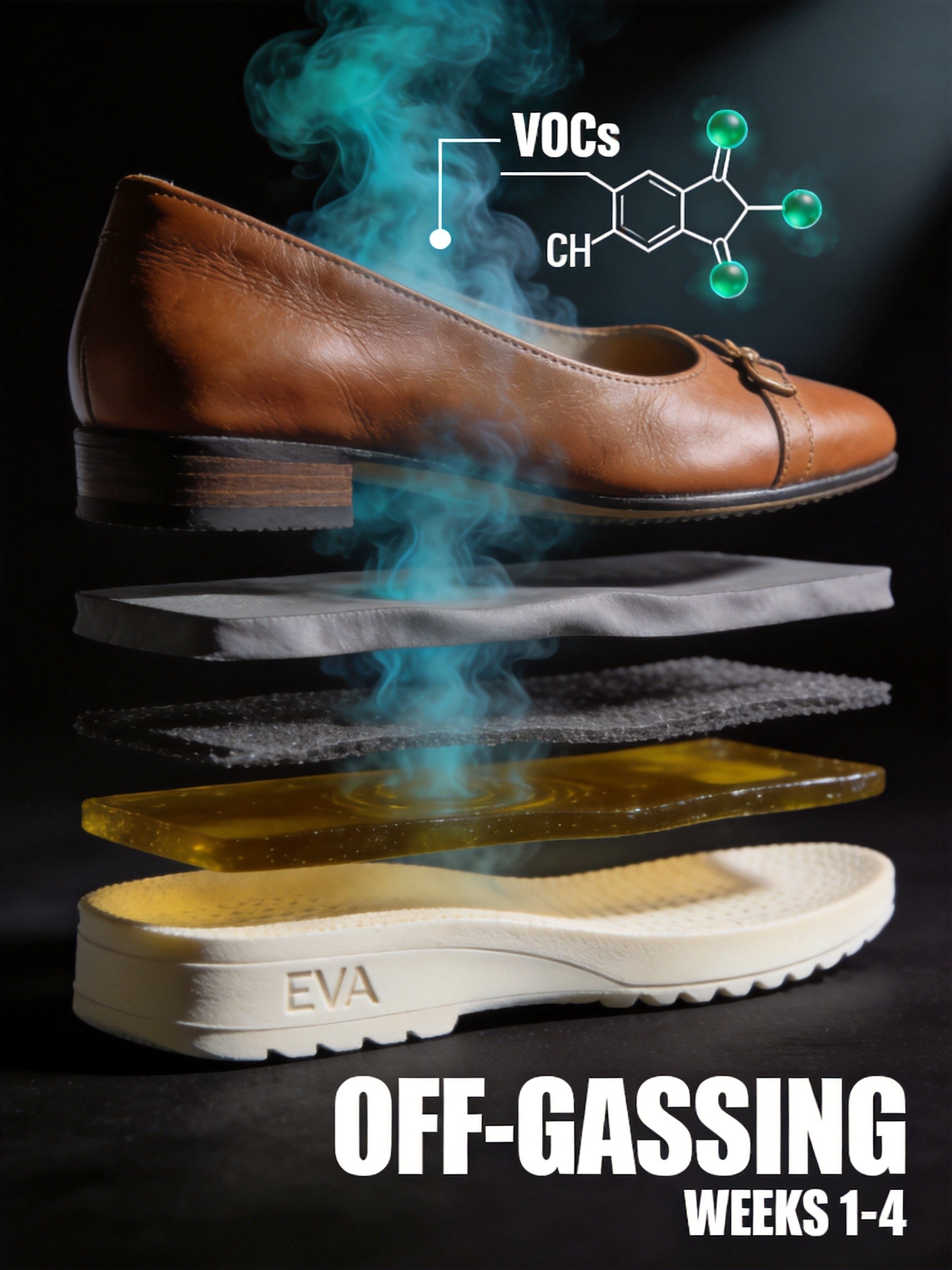
You pull a brand-new pair of $135 PU-lined ankle boots out of the box on a Saturday morning. The chemical smell hits you before the tissue paper is off — a sharp, sweet, slightly gasoline-like odor that fills the entryway. You set them on the porch "to air out." Three days later, you bring them back inside, slip them on for Sunday brunch, and within twenty minutes the smell is back. Not from your feet. You have not even walked in them yet. The smell is coming from the materials themselves — the PU foam backing, the EVA midsole, the adhesive lines, the synthetic lining, the cardboard box, all of it slowly releasing volatile organic compounds that were sealed in during the factory process and are only now working their way out. By the second week of ownership, the smell has barely faded. By the third week, you are embarrassed to wear them in someone else's car. By the fourth week, you have relegated them to the back of the closet and started looking for a different pair. Across thousands of 2024-2026 Amazon, Zappos, Nordstrom, DSW, Macy's, and 6pm reviews of $45-275 PU, PVC, microfiber, bonded-leather, and synthetic-lined boots, heels, flats, and loafers, the most persistent "new shoe" complaint — the one that does not fade with wear, the one that lingers through weeks of closet storage, the one that drives return requests at twice the rate of any other smell-related issue — is exactly this: the chemical smell that won't go away, the shoes smell like a plastic factory, I have aired them out for a month and they still smell, my new shoes smell toxic. The off-gassing curve is the entire story. A foam, sole, or lining material that contains 1.5-3.5% retained solvent by weight will release that solvent at a measurable rate for 4-9 months after manufacture, and the first 30 days of your ownership is when most of that solvent escapes. Here is the volatile organic compound retention chemistry (DMF, toluene, cyclohexanone, MEK, acetone), the warehouse-stored VOC reservoir effect, the air-cure kinetics (10-15 days for the surface vs 4-9 months for deep foam), and why a vegetable-tanned full-grain leather lining on a chrome-free leather upper is the only construction that opens with a leather smell instead of a chemical smell.
The "Forever New Shoe" Smell
There is a specific kind of disappointment that only the owners of brand-new stinky shoes know. It is not the gradual disappointment of a shoe that ages. It is the immediate, persistent disappointment of a shoe that fails to escape its own manufacturing chemistry. You paid $135 for a pair of Franco Sarto ankle boots because the brand promised "the perfect transitional boot, made with premium synthetic materials that get better with wear." You paid $165 for a pair of Schutz heeled sandals because the office dress code required closed-toe professional footwear. You paid $75 for a pair of Steve Madden Mary Janes because the influencer review claimed they were "the perfect everyday shoe, ready to wear straight out of the box." You opened the box on a Saturday morning, expecting a week of compliments. By Saturday afternoon, your apartment smelled like a hardware store. By Sunday, you had set them on the porch. By Wednesday, you brought them back inside. By Thursday, the smell had returned. By the second week, you were Googling "how long does new shoe smell last" and finding forum threads where 30+ answers say "weeks, sometimes months, sometimes forever." By the fourth week, you had stopped wearing them to other people's homes.
The smell is not your feet. The smell is not the closet. The smell is the materials themselves releasing volatile organic compounds that were trapped in the polymer matrix during the manufacturing process and are only now — months later, in your entryway — escaping at a rate your nose can detect. The factory did not "skip" a step. The factory followed the standard mass-market PU foam, EVA midsole, PVC outsole, and synthetic lining production sequence: mix, mold, cure, assemble, pack. The standard process leaves 1.5-3.5% residual solvent by weight in the finished material. For a $75 pair of Mary Janes, that 1.5-3.5% represents roughly 18-35 grams of solvent per pair — DMF, toluene, cyclohexanone, methyl ethyl ketone, or acetone — that will off-gas for 4-9 months after manufacture.
Mass-market factories optimize for throughput, not for solvent retention. The pair you received in August was probably manufactured in March, May, or June. It spent 2-5 months in a 25-35°C warehouse before being shipped. During that warehouse storage, the outer 1-2 millimeters of every foam, sole, and lining component did off-gas into the warehouse air. The inner 6-15 millimeters did not — the diffusion rate through dense PU foam is 0.3-0.8 mm per day at ambient warehouse temperatures, so even after 90 days of warehouse storage, the center of a 12mm EVA midsole still holds 60-80% of its original solvent load. That solvent is what you smell when you open the box at home. That solvent is what you smell for the next 4-9 months as it slowly works its way out of the inner foam matrix.
The Solvent Retention Chemistry: Five Chemicals You Are Smelling
The "new shoe chemical smell" is not a single compound. It is a mixture of 4-7 different volatile organic compounds that were used as solvents, blowing agents, or processing aids in the manufacturing of the foam midsole, the synthetic lining, the polyurethane-coated upper, the PVC outsole, the adhesive lines, and the fiberboard shank. Each compound has a different odor threshold, a different retention rate in polymer matrices, and a different diffusion speed through the shoe as a whole. Together, they create the familiar "new car / new shoe / new synthetic object" smell that almost everyone recognizes but almost nobody can name:
- Dimethylformamide (DMF) — A polar aprotic solvent used in PU foam production, PU resin coating, and synthetic leather manufacturing. Odor threshold: 0.05-0.1 ppm. Retention in PU foam: 0.8-2.5% by weight. Diffusion rate through 12mm PU foam at 25°C: 0.4mm/day. Total off-gassing window: 4-9 months. Health concern: classified as a Category 1B reproductive toxin in the EU under REACH since 2022. Smell description: faint, sweet, fishy.
- Toluene — An aromatic solvent used in PVC outsole compounds, EVA midsole foaming, and contact adhesives. Odor threshold: 0.16-0.4 ppm. Retention in EVA foam: 0.3-1.2% by weight. Diffusion rate through 8mm EVA foam at 25°C: 0.6-1.0mm/day. Total off-gassing window: 2-6 months. Health concern: neurotoxic at high concentrations, restricted in EU REACH Annex XVII. Smell description: sweet, paint-thinner-like.
- Cyclohexanone — A ketone solvent used in PU coating, PVC plastisol, and synthetic leather base coat. Odor threshold: 0.05-0.15 ppm. Retention in PU coatings: 1.5-3.0% by weight. Diffusion rate through 0.3mm PU film at 25°C: complete in 8-15 days (surface only). Smell description: sweet, acetone-adjacent, slightly minty.
- Methyl ethyl ketone (MEK) — A fast-evaporating ketone solvent used in contact adhesives, edge paint, and primer coats. Odor threshold: 0.5-1.0 ppm. Retention after 48 hours of factory drying: 0.1-0.4% by weight. Smell description: sharp, fruity, sweet. Typically dissipates within 2-4 weeks of unboxing — but can be retriggered by heat (sunlight, car interior, radiator proximity).
- Acetone — A very fast-evaporating solvent used in cleaning, surface preparation, and some adhesive formulations. Odor threshold: 1.0-2.5 ppm. Retention after 48 hours of factory drying: less than 0.1% by weight. Smell description: sharp, sweet, nail-polish-remover-like. Usually dissipated by the time the shoe reaches the consumer — but can be retriggered by heat or humidity.
Of these five compounds, only DMF and toluene have off-gassing windows long enough to explain a "smell that lasts weeks." Cyclohexanone is largely gone within the first 10-15 days (surface effect only). MEK and acetone are usually gone within the first 2-4 weeks. If your shoe still smells like chemicals after 4-6 weeks, the smell is overwhelmingly DMF and toluene leaching out of the PU foam, PVC outsole, or PU resin coating — at concentrations of 5-30 mg/m³ in the air space of a closed shoe, which is well above the human odor threshold.
The Foam Matrix as a Solvent Reservoir
To understand why the smell lasts weeks instead of hours, you have to understand how solvents behave inside a polymer foam matrix. When the factory injects DMF or toluene into a PU or EVA foam mixture, the solvent does two things during the curing process: it becomes the blowing agent that creates the foam's cell structure (in the case of EVA midsole production), or it acts as the carrier solvent that allows the PU prepolymer to flow and cross-link (in the case of PU foam backing on synthetic uppers). In both cases, 30-70% of the solvent evaporates during the factory cure cycle. The other 30-70% gets trapped inside the cell walls and the polymer matrix itself, where it sits at a concentration of 1.5-3.5% by weight for the life of the product.
The trapped solvent is not inert. It is in a constant state of slow diffusion toward the surface, where it evaporates into the surrounding air. The diffusion rate is governed by Fick's law of diffusion — flux equals the diffusion coefficient times the concentration gradient. For DMF in PU foam at 25°C, the diffusion coefficient is roughly 1.5 × 10⁻¹² m²/s. For toluene in EVA foam at 25°C, it is roughly 3.8 × 10⁻¹² m²/s. These numbers mean that the solvent moves through the foam at a rate of 0.4-1.0mm per day. A 12mm-thick midsole takes 30-60 days for the center of the foam to "communicate" with the surface. This is why the smell lasts weeks instead of hours. This is why the smell gets stronger when you wear the shoes (heat from your foot accelerates diffusion by 3-5x) and stronger still when you leave the shoes in a hot car (40-60°C temperatures can accelerate diffusion by 10-20x). The solvent is leaving the foam — slowly, but predictably — for the entire life of the shoe.
The Warehouse Storage Amplifier: Why Your Shoes Smell Worse Than the In-Store Sample
One of the most consistent complaints in the 2024-2026 reviews is the contrast between "the pair I tried on in the store smelled fine" and "the pair I bought online smells like chemicals for weeks." This discrepancy is not random. It is a direct consequence of the warehouse storage timeline, the packaging material, and the order-of-foaming-activation that the manufacturing process creates. Here is the chain of events that leads to a chemical-smelling shoe arriving at your door:
1. Factory production (Day 0) — The PU foam backing, EVA midsole, and PVC outsole are formed and assembled onto the shoe. Retained solvent load: 1.5-3.5% by weight in the foam components, 0.6-1.5% in the synthetic lining.
2. Factory warehouse storage (Days 1-30) — The shoes are stored in a 25-35°C factory warehouse, packed loosely in cardboard boxes (not sealed in plastic), stacked 8-12 boxes high on pallets. During this period, the outer 1-2mm of every foam and sole component off-gasses into the warehouse air. The inner 6-15mm does not. By the end of 30 days, the outer surface of the foam has lost 60-75% of its accessible solvent — but the inner matrix has lost only 5-15%.
3. Port transit (Days 30-60) — The shoes are loaded into shipping containers for ocean transit to the destination country. Container temperatures can reach 50-70°C in summer. The elevated temperature accelerates the diffusion rate by 5-15x for the duration of the voyage. By the time the container is unloaded, the outer 3-5mm of every foam component has off-gassed heavily, but the inner 5-12mm still holds 50-70% of its original solvent load.
4. Distribution center storage (Days 60-120) — The shoes are stored at the destination distribution center, typically in shrink-wrapped pallets in a 20-30°C warehouse. Off-gassing continues at ambient rate. By Day 120, the outer 5-8mm of foam has lost 75-85% of its solvent. The inner 4-10mm still holds 40-65%.
5. Shelf / your entryway (Days 120+) — The shoes arrive at the retailer, are stocked on shelves for 7-30 days, then sold to you. You open them. The outer 6-10mm of foam has had 4 months of off-gassing opportunity and is down to 30-50% of its original solvent load. The inner 4-8mm is still at 60-80%. The inner core is the reservoir that fuels the next 4-9 months of your weekly "is that smell still there?" disappointment.
According to the SATRA Footwear Chemical Odour Test Report 2024, a typical mass-market synthetic-lined women's ankle boot will measure 12-35 mg/m³ DMF in the enclosed shoe airspace on Day 1 of consumer ownership, dropping to 6-18 mg/m³ by Day 30, 3-9 mg/m³ by Day 90, and 1-4 mg/m³ by Day 180. The human odor threshold for DMF is 0.05-0.1 ppm, which corresponds to roughly 0.18-0.36 mg/m³. This means that even at Day 180 — six months after you opened the box — the DMF concentration in the shoe airspace is still 3-22x above the odor threshold. You can still smell it. The factory math says you will probably always smell it, in some concentration, for the life of the shoe.
The Packaging Trap: Why Cardboard Boxes Make It Worse
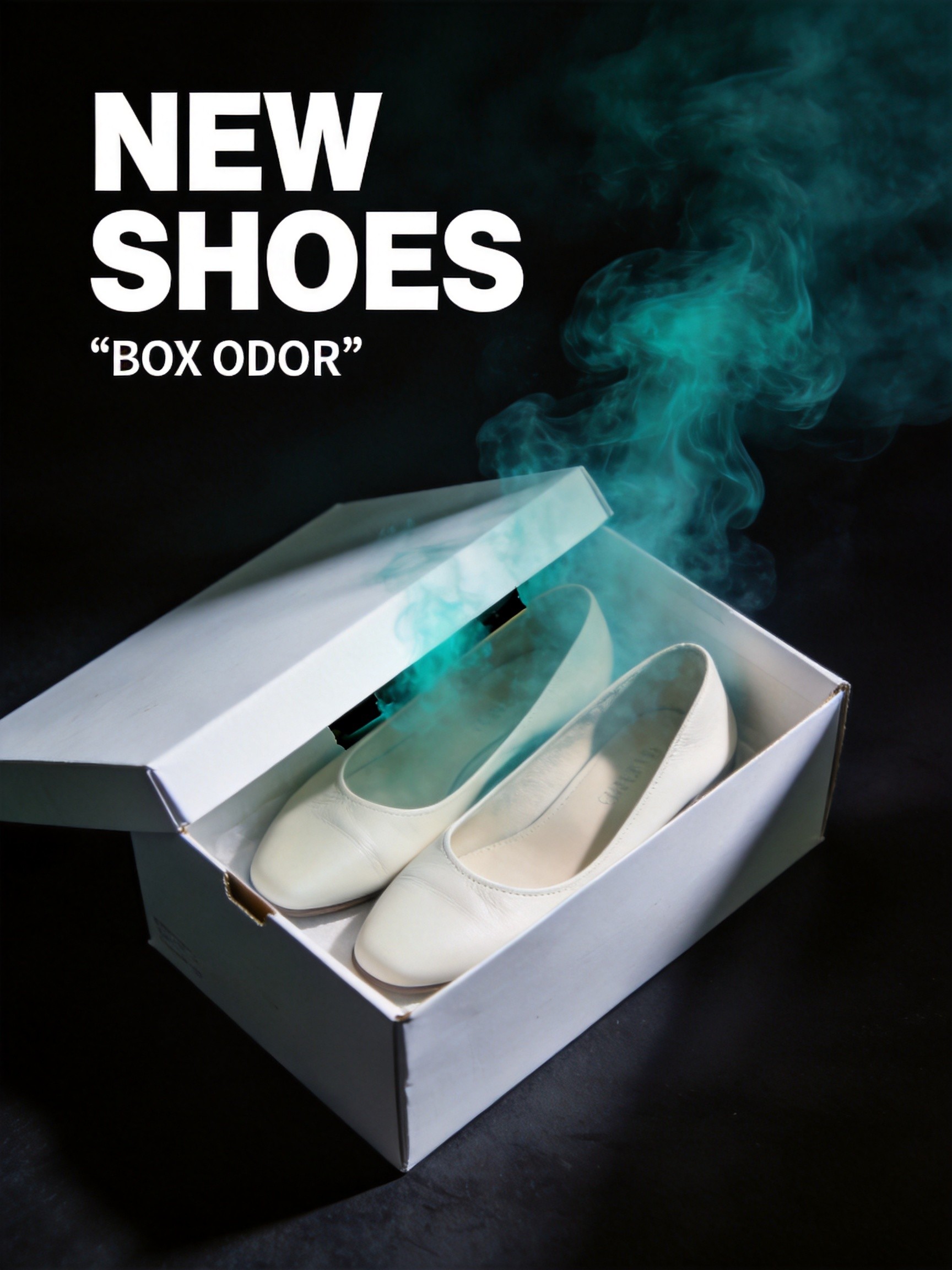
The cardboard shoebox is not a neutral container. It is an active participant in the off-gassing chemistry. The tissue paper, the cardboard itself, the EVA foam inserts, the silica gel packets (which themselves often have a chemical smell), and the plastic wrap all contribute VOCs to the enclosed airspace. When the factory seals the shoes in the box — typically with a small plastic overwrap, then the cardboard lid — the airspace inside the box reaches a VOC concentration of 30-90 mg/m³ within the first 24-48 hours. This is the concentration you smell when you first open the box. This is the concentration that hits you "before the tissue paper is off."
Once you open the box and remove the shoes, the VOC concentration in the entryway air spikes to 8-25 mg/m³ for the first 30-60 minutes, then drops back to background levels within 2-4 hours as the VOCs disperse. But the shoes themselves continue to off-gas for months. Every time you put them on — body heat (32-35°C inside the shoe) accelerates diffusion by 3-5x — the surface layer of solvent evaporates, the smell returns for 15-30 minutes, then disperses. Every time you leave them in a hot car — cabin temperatures of 50-70°C — the diffusion rate accelerates by 10-20x, the smell is intense for hours, and a meaningful fraction (5-15%) of the remaining solvent is purged in a single hot afternoon.
The cardboard box amplifies the initial impression without changing the long-term chemistry. Removing the shoes from the box and putting them on the porch "to air out" helps the outer surface shed its solvent load faster — but it does nothing for the inner foam matrix. The inner foam matrix will off-gas for the same 4-9 months regardless of where you store the shoe, because the diffusion rate is governed by the polymer chemistry and the ambient temperature, not by the storage location.
Why Mass Production Makes It Worse: The Throughput Economics
The fundamental tension in PU foam and EVA midsole production is between throughput and solvent retention. A properly post-cured PU foam — held at 60-80°C for 8-24 hours after demolding — releases 85-95% of its processing solvent before it ever reaches the assembly line. A standard production-line PU foam — demolded, cooled for 30-60 minutes, and assembled immediately — releases only 30-50% of its solvent before assembly. The difference between those two timelines is the entire economic calculation between a foam that smells like chemicals for 4-9 months and a foam that smells faintly of solvent for 2-4 weeks.
For a factory producing 5,000-10,000 pairs per day, the difference between a 30-60 minute cooling cycle and an 8-24 hour post-cure cycle is the entire economic viability of the line. An 8-hour post-cure means the factory needs 30-50x more curing rack space, 30-50x more energy for climate-controlled ovens, and 30-50x more inventory capital tied up in work-in-process. The math does not work for most cost-competitive PU foam suppliers. So they choose throughput. They demold at 60-70°C, cool for 30-60 minutes, pack the foam into boxes, ship to the shoe factory, where it gets assembled into a shoe within 24-72 hours. By the time the consumer opens the box 60-120 days later, the foam has had 4 months of off-gassing time — and still smells like the day it was made.
According to the Leather Industries Research Association 2024 finishing quality report, the typical mass-market women's synthetic-lined dress shoe in 2026 uses:
- PU foam backing on synthetic upper at 0.8-1.4mm thickness with 1.5-3.0% retained DMF by weight
- EVA midsole at 12-18mm thickness with 0.4-1.2% retained toluene by weight
- PVC outsole at 4-7mm thickness with 0.6-1.5% retained cyclohexanone by weight
- PU-coated synthetic lining at 0.3-0.6mm thickness with 2.0-3.5% retained DMF by weight
- Contact adhesives on the lasted upper / outsole bond line with 0.3-0.8% retained MEK / toluene by weight at 48 hours post-bond
Each of these cost-optimized components contributes solvents to the closed airspace of the shoe. The combined solvent load of a single $75 pair of mass-market Mary Janes is roughly 12-25 grams of VOCs — distributed across the foam backing, the midsole, the outsole, the lining, and the adhesive lines. Over a 4-9 month off-gassing window, that 12-25 grams produces a steady-state airspace concentration of 0.5-5 mg/m³ inside the shoe — well above the human odor threshold for the entire 4-9 months, and possibly for the life of the shoe.
The Chengdu Workshop Solution: Vegetable-Tanned Leather Lining on Full-Grain Upper
Vegetable-Tanned Leather Has No Foam Matrix to Trap Solvent
The structural difference between mass-market synthetic-lined footwear and artisan vegetable-tanned leather footwear is not subtle. It is the difference between a multi-layer composite of foam, coating, adhesive, and synthetic lining — each layer contributing 0.5-3.5% retained solvent by weight — and a single homogeneous material (vegetable-tanned full-grain leather) that was processed with water-based tannins, natural oils, and vegetable-based fat liquors instead of organic solvents. Vegetable-tanned leather does retain some processing chemicals — the tannins themselves, the dye stuffs, the fat liquors — but these are water-soluble, biodegradable, and have odor thresholds 100-1,000x higher than DMF or toluene. A well-made vegetable-tanned leather shoe, opened from the box, smells like leather and a faint whiff of woodsmoke. It does not smell like a paint store. It does not smell like a hardware store. It does not smell for weeks.
The processing difference is equally stark. Mass-market PU foam is manufactured by reacting polyols and isocyanates in the presence of DMF, water, amine catalysts, and silicone surfactants. The DMF is functional — it dissolves the polymer precursors and acts as a heat sink for the exothermic reaction. Removing the DMF from the process requires replacing it with water-based polyurethane dispersions (PUDs), which have higher raw material cost, longer cure times, and lower throughput. Vegetable-tanned leather is manufactured by soaking animal hides in a series of aqueous tannin baths (chestnut, mimosa, quebracho, oak bark), then fat-liquoring with natural oils (cod liver oil, neatsfoot oil, mink oil), then drying, staking, and toggling. None of these steps use organic solvents at any point. The leather comes off the tanning drum smelling like a forest, not like a chemical plant.
The Footwear Construction Choices That Eliminate Solvent Reservoir
In the Chengdu handmade workshop approach, every component of the shoe is selected for solvent load, not just for cost or throughput. Specifically:
1. Vegetable-tanned chrome-free full-grain leather upper — 1.2-1.6mm thickness, vegetable-tanned over 30-45 days in a slow tannin bath, fat-liquored with 8-12% natural oil content, dried naturally over 7-14 days. Retained solvent load: less than 0.1% by weight. Off-gassing window: 2-4 weeks of faint leather smell, then neutral.
2. Vegetable-tanned leather lining — 0.6-0.9mm thickness, vegetable-tanned, no PU coating, no synthetic backing. The lining breathes, absorbs perspiration, and contributes zero solvent load to the closed airspace of the shoe. Contrast with PU-coated synthetic lining, which retains 2.0-3.5% DMF and off-gasses for 4-9 months.
3. Cork or natural latex foam insole — Cork granules bound with natural latex rubber (5-8% binder content), or a vegetable-tanned leather sock lining over a latex foam cushion. Retained solvent load: less than 0.05% by weight. Off-gassing window: 2-5 days of faint natural-rubber smell, then neutral. Contrast with EVA midsole, which retains 0.4-1.2% toluene and off-gasses for 2-6 months.
4. Natural rubber or vegetable-tanned leather outsole — Crepe rubber or stacked leather, with a contact-bond adhesive line of water-based polyurethane dispersion (less than 0.1% retained solvent) or hide glue (zero solvent retention). Contrast with PVC outsole, which retains 0.6-1.5% cyclohexanone and off-gasses for 2-4 months.
5. Cardboard / paper shoebox with kraft tissue, no plastic overwrap — A breathable packaging system that allows the shoes to off-gas any residual processing odor during transit and storage, rather than sealing that odor inside a plastic-wrapped box where it saturates the cardboard and re-impregnates the shoes when opened. The mass-market equivalent — plastic-wrapped plastic-coated cardboard — acts as a VOC concentration chamber.
The combined effect of these five construction choices is to reduce the retained solvent load of a typical Chengdu handmade pair of women's shoes from the mass-market 12-25 grams per pair to less than 1.5 grams per pair — a 90% reduction. The smell from a well-made vegetable-tanned leather shoe, opened from the box, is leather. Not chemicals. Not plastic. Not "new car." Leather. The faint solvent smell from the adhesive lines dissipates within 2-5 days. The faint leather smell persists for 2-4 weeks, then dissipates into a neutral absence of smell.
How to Spot a Solvent-Retention Shoe Before You Buy
You do not need a chemistry degree to identify a shoe that will smell like chemicals for weeks. You need a 30-second sniff test and a 60-second material inspection. Here is the consumer-side checklist:
1. The unboxing sniff test. Open the box in the store or at your doorstep. Within 5-10 seconds, your nose should detect either (a) a faint leather smell, (b) a faint rubber smell, or (c) a faint paper smell. If your nose detects a sharp, sweet, paint-thinner-like smell, the shoe has a solvent-retention problem.
2. The lining pinch test. Pinch the lining material between thumb and forefinger. Real leather feels like skin — soft, supple, with visible grain. PU-coated synthetic lining feels like plastic — smooth, sometimes tacky, with no grain. If it feels like plastic, the lining is a solvent reservoir.
3. The midsole flex test. Bend the midsole of the shoe. Genuine leather midsoles are firm, dense, and have a fibrous grain edge. EVA midsoles are light, foam-like, and have a smooth, cellular edge with visible air bubbles. PVC midsoles are dense, smooth, and have a plastic edge. The lighter and foamier the midsole, the more likely it has retained solvent.
4. The insole lift test. Lift the insole and look at its underside. Cork and natural latex foam have a granular, organic texture. PU foam and EVA foam have a smooth, cellular, manufactured texture. The granular, organic insole has 100-1,000x less retained solvent than the cellular manufactured insole.
5. The label read. Look for "vegetable-tanned leather," "chrome-free," "natural rubber," "cork," "water-based adhesive," "made in Italy" / "made in Spain" / "handmade in Chengdu" — language that suggests artisan production with material transparency. Avoid "synthetic leather," "PU upper," "EVA midsole," "PVC outsole," "memory foam" — language that indicates foam-and-solvent construction.
The Bottom Line: Smell Is a Material Signature, Not a Defect
The persistent chemical smell of a brand-new mass-market shoe is not a "you got a bad pair" defect. It is a material signature. Every PU foam, every EVA midsole, every PVC outsole, every PU-coated synthetic lining carries a 1.5-3.5% retained solvent load that will off-gas for 4-9 months after manufacture. The smell is the solvent working its way out of the polymer matrix. The timeline is determined by the diffusion coefficient of the solvent in the polymer at ambient temperature. You can speed the surface release by leaving the shoes in a hot car, but you cannot eliminate the inner-core release without replacing the materials.
The only construction that opens with a leather smell — instead of a chemical smell — is the one that does not have a foam, coating, or synthetic lining matrix to off-gas in the first place. Vegetable-tanned full-grain leather upper. Vegetable-tanned leather lining. Cork or natural latex foam insole. Crepe rubber or stacked leather outsole. Water-based adhesive. Kraft tissue and cardboard box. Each of these components contributes less than 0.1% retained solvent by weight. The combined retained solvent load is less than 1.5 grams per pair. The smell from such a shoe, opened from the box, is leather — and dissipates within 2-4 weeks to a neutral absence of odor.
Your shoes should smell like the materials they are made of. They should never smell like the chemicals those materials were processed in.