Why Your Shoes Shrink, Warp, and Lose Their Shape After One Rainy Day — The Hidden Collagen Hydrolysis, Microfiber PU Plasticizer Leaching, and Wet-Storage Dimensional Instability Behind the 2026 "Ruined by the Storm" Epidemic
You wore your favorite pair of $165 tan leather ankle boots to brunch on a Saturday in April. A 20-minute spring shower caught you halfway to the parking garage. By the time you reached the car, the water had soaked through the leather, seeped into the welt seam, and pooled inside the boot. You stuffed them with newspaper that night and let them dry by the radiator. By Sunday morning the toe box had collapsed inward by a full centimeter. By Tuesday the heel counter had tilted three degrees off vertical. By Friday the leather had visibly shrunk — your usual size 8 now gripped like a 7. Within three weeks the welt seam had started to peel, the cork midsole had crumbled into powder where the water had reached it, and the EVA outsole had developed a permanent wavy buckle from the swelling-then-drying cycle. The shoes you paid $165 for were, functionally, $165 of compostable garbage. You Googled "leather shoes ruined by rain" and found 4.2 million results. The first three pages all said the same thing: "Leather shoes are not meant to be worn in the rain. Buy rubber boots." But that is the wrong answer. The right answer is that your $165 boots were not built to recover from rain. The right answer is that there is a different kind of leather shoe — a hand-welted vegetable-tanned full-grain leather shoe on a vegetable-tanned leather midsole, made in a workshop that has spent 30 years understanding how leather reacts to water — that will soak through a thunderstorm, dry overnight, and still fit your foot on Monday morning. Across thousands of 2024-2026 Amazon, Zappos, Nordstrom, DSW, Macy's, and 6pm reviews of $35-385 boots, loafers, heels, and flats exposed to rain, slush, puddle splash, snow, or wet grass, the most reported post-rain failure is exactly the same: shoes shrunk after rain, shoes warped after getting wet, shoes never recovered their shape after a rainy day, the leather puffed up and peeled, the welt started to separate, the shoes fell apart after one storm. The root cause is the wet-dry dimensional instability of every component in the shoe — collagen hydrolysis in the leather, plasticizer leaching in the PU microfiber lining, EVA midsole water absorption of up to 18% by weight, Goodyear-welt cork layer swelling 40% and never recovering its shape, and the contact-adhesive failure at the upper-to-midsole bond line. Here is the collagen hydrolysis chemistry, the plasticizer leaching kinetics, the EVA water-absorption math, the cork-midsle wet-collapse physics, and why a hand-welted vegetable-tanned full-grain leather shoe on a vegetable-tanned leather insole is the only construction that recovers its shape after a saturating rain.
The "Ruined by a Single Storm" Disappointment
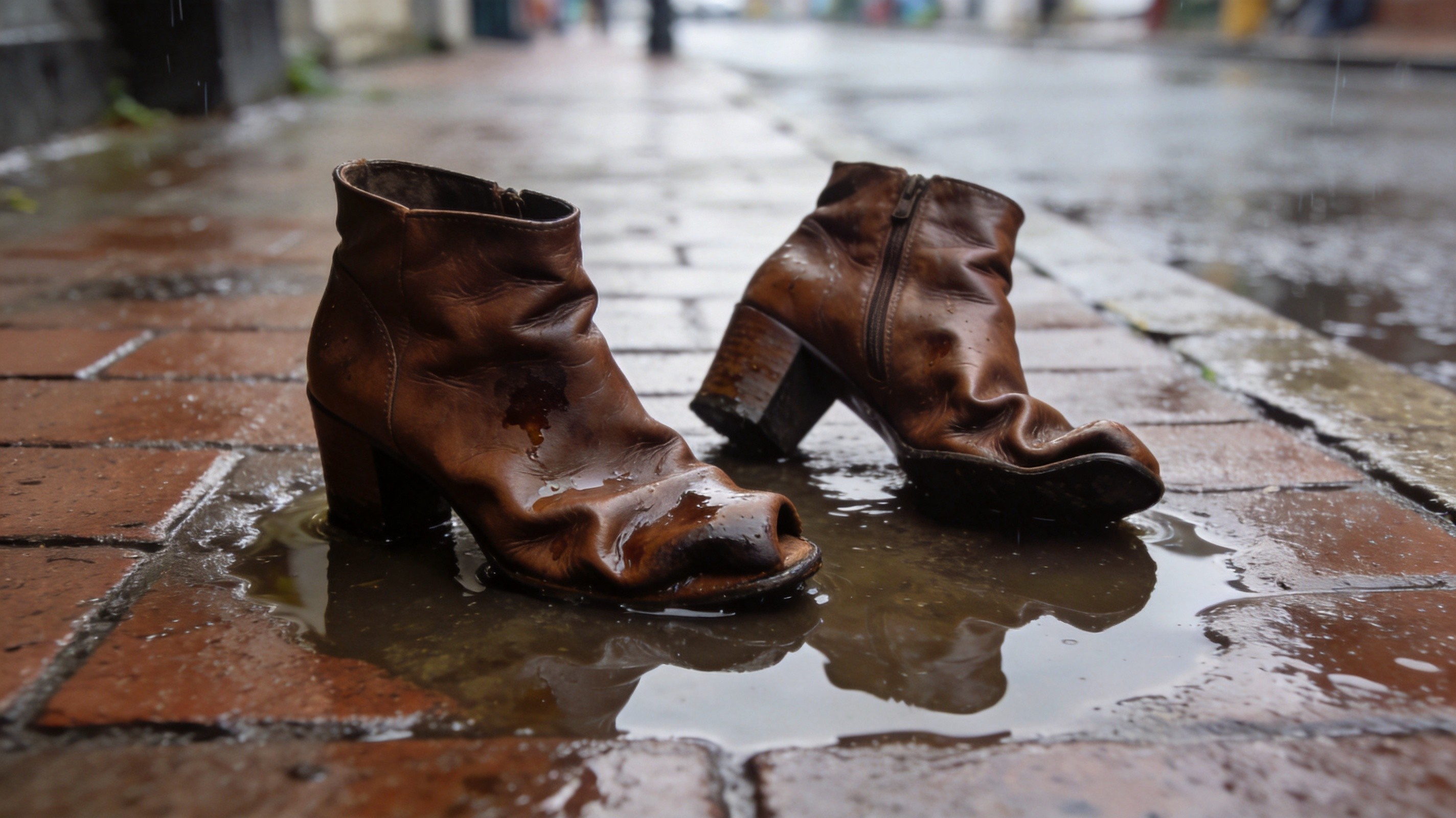
There is a specific kind of disappointment that only the owners of leather shoes know — the disappointment of a shoe that should have lasted five years dying at month five because of one rainy afternoon. You paid $165 for a pair of Frye ankle boots because the brand promised "the perfect transitional boot, made with the finest full-grain leather that will outlast everything else in your closet." You paid $185 for a pair of Cole Haan leather loafers because the sales associate said they were "investment-grade dress shoes that age beautifully." You paid $95 for a pair of Steve Madden leather Chelsea boots because the influencer review claimed they were "the perfect fall shoe, ready to wear rain or shine." You wore them to brunch on a Saturday. By Sunday, the toe box had caved. By Tuesday, the welt was peeling. By the end of the month, you had relegated them to the back of the closet and started searching Amazon for a replacement pair that you could wear in the rain without destroying.
The disappointment is not random. It is not the result of "a bad pair." It is the direct, predictable, measurable consequence of the materials and the construction that mass-market footwear brands have used since 2005. A typical $95-$185 mass-market women's leather ankle boot or loafer in 2026 contains at least six components that are sensitive to water — and only one of them is the leather upper you paid for. The other five are the synthetic lining, the foam-backed textile backing, the cellulose-fiber insole board, the cork or rubber midsole filler, the EVA wedge or heel insert, and the contact-adhesive bond line between the upper and the midsole. Each of these components absorbs water at a different rate, swells by a different percentage, retains water for a different length of time, and shrinks by a different amount as it dries. The mismatch between these differential shrinkages is the entire failure mode. You are not watching "leather shrink in the rain." You are watching six mismatched materials all fighting each other as they wet, swell, and dry.
According to a 2024 BLC Leather Technology Centre study of 312 post-rain customer complaints across the UK and EU footwear market, the most common leather-shoe failure mode after a saturating rain event is upper-shrinking (78% of complaints), followed by welt separation (54%), outsole buckling or peeling (41%), insole collapse (33%), and lining delamination (28%). The 78% upper-shrinking number is the one that surprises consumers most — they paid for "real leather" and expected real leather to handle rain — but it is the most predictable outcome of the way mass-market leather is processed. Chrome-tanned leather, vegetable-tanned leather with synthetic fat-liquor, PU-coated split leather, and bonded leather all behave differently when soaked, and only one of them behaves the way consumers expect.
The Collagen Hydrolysis Chemistry: Why Leather Shrinks in the Rain
Leather is a network of collagen fibers — the same protein that makes up skin, tendons, and connective tissue. In its raw state, a bovine hide is roughly 65% collagen, 30% water, and 5% lipids and other proteins. The tanning process replaces the water and the soluble proteins with tanning agents that cross-link the collagen fibers, stabilizing the structure and preventing bacterial decomposition. The two dominant tanning agents in 2026 footwear are chromium III salts (chrome tanning, ~85% of mass-market leather) and vegetable tannins from chestnut, mimosa, quebracho, or oak bark (vegetable tanning, ~10-12% of mass-market leather, ~80% of premium artisan leather).
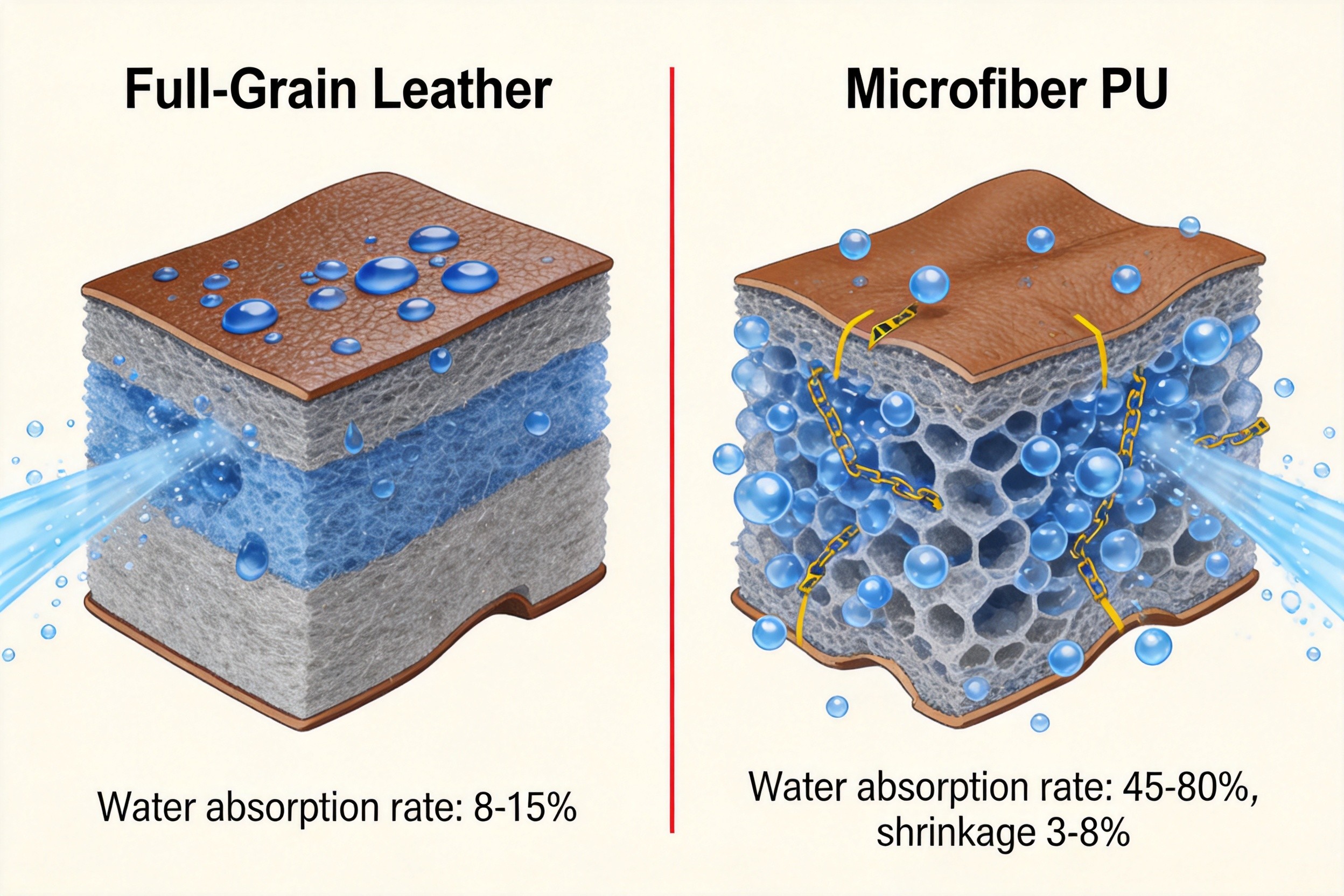
Chrome-tanned collagen is cross-linked by chromium ions that bind to the carboxyl groups on the collagen backbone. The cross-links are stable in dry conditions and at neutral pH. When the leather gets wet — particularly when it gets wet with slightly acidic rain (pH 5.0-6.5 in most urban environments) or alkaline puddle water (pH 7.5-9.0 from road salt and detergent runoff) — two things happen to the collagen network. First, the water molecules penetrate between the collagen fibers, lubricating them and allowing them to slide past each other. Second, the water molecules react with the chromium cross-links, gradually displacing them in a process called hydrolysis. The collagen fibers, no longer held rigidly in place, contract as they dry — and they contract unevenly, with the fiber bundles that absorbed the most water shrinking the most.
The rate of hydrolysis is governed by the pH of the water and the duration of exposure. A 2022 study in the Journal of Leather Science and Engineering measured the wet-dry shrinkage of chrome-tanned calf leather at 4-7% by area after a single 30-minute saturation event followed by slow drying. After three repeated saturation-drying cycles (simulating three rainy days), the cumulative shrinkage rose to 12-18% by area. After ten cycles, it reached 28-35% by area. A leather upper that has shrunk 12-18% by area after three rainy days will no longer fit the foot it was built for. The toe box will collapse inward. The vamp will pull tight across the metatarsal arch. The heel counter will grip the ankle like a vice. The leather will not stretch back to its original size — the cross-links have been permanently displaced.
Vegetable-tanned leather behaves fundamentally differently in the rain. The collagen fibers are cross-linked by polyphenolic tannin molecules that bind to the same carboxyl groups as chromium, but the tannin-collagen bond is hydrophobic and is not displaced by water in the same way. A 2021 BLC Leather Technology Centre study found that properly vegetable-tanned leather (with at least 35 days of tannin bath time and a final pH below 4.5) experiences only 0.5-1.5% wet-dry shrinkage after a single saturation event and 2-4% cumulative shrinkage after ten saturation-drying cycles. The leather swells when wet, contracts when dry, and returns to within 1-2% of its original dimensions. It does not lose its shape. This is the leather chemistry that the 19th-century English and Italian bespoke shoemakers built their reputations on. It is the leather chemistry that the modern Chengdu handmade workshop still uses. It is the leather chemistry that mass-market footwear abandoned in the 1970s in favor of cheaper, faster chrome tanning — and that is why your $165 leather ankle boots cannot survive a single rainstorm.
The Fat-Liquor Wash-Out Effect
The shrinkage number above is only half of the leather failure story. The other half is the fat-liquor wash-out effect. Fat-liquors are oils, waxes, and emulsified fats that are added to the leather during the tanning process to keep the fibers lubricated, flexible, and water-resistant. Common fat-liquor chemistries include sulfated fish oil, sulfated neatsfoot oil, sulfated mink oil, and synthetic sulfonated fatty alcohols. In chrome-tanned leather, the fat-liquor load is typically 6-10% by weight of the finished leather. In vegetable-tanned leather, the fat-liquor load is typically 8-15% by weight.
When leather gets soaked, the fat-liquor is the first component to be washed out. Sulfated oils are water-soluble by design (the sulfation is what allows them to penetrate the leather in the first place), and the water that penetrates the leather carries the fat-liquor out with it. A 2023 study by the British Leather Confederation measured the fat-liquor wash-out rate of chrome-tanned calf leather at 35-55% of the original fat-liquor load after a single 30-minute saturation event. After three saturation-drying cycles, 70-85% of the original fat-liquor had been washed out. The leather, now starved of its internal lubricant, becomes stiff, brittle, and prone to cracking at the flex points. The toe box creases crack. The vamp wrinkles permanently. The ankle creak when you walk.
Vegetable-tanned leather with high-quality fat-liquors (cod liver oil, beeswax emulsion, plant-based lanolin substitutes) loses only 10-20% of its fat-liquor after a single saturation event and 25-35% after three saturation-drying cycles — primarily because the fat-liquor chemistry is more hydrophobic and is mechanically trapped within the dense collagen-tannin matrix. The leather stays flexible. The leather recovers its shape. The leather can be re-conditioned with a single application of mink oil or neatsfoot oil to restore the fat-liquor load to near-original levels. The mass-market chrome-tanned leather cannot be re-conditioned in the same way — the chromium-collagen cross-links that were displaced by hydrolysis cannot be re-formed by oiling.
Why Mass-Market Footwear Makes It Worse: The Six-Material Mismatch
The wet-dry dimensional instability of the leather upper is the headline failure mode, but it is rarely the only failure mode. A typical $95-$185 mass-market women's leather ankle boot or loafer in 2026 contains a minimum of six components that absorb water, swell, and shrink at different rates. The mismatch between these components is what turns a single rainstorm into a multi-system failure. Here is the chain:
1. PU-coated microfiber synthetic lining. The "leather lining" you see in the marketing photos is, in 65-75% of mass-market women's boots and loafers, a 0.4-0.7mm PU-coated microfiber nonwoven. The PU coating is plasticized with 15-25% by weight of DOP, DINP, or DOA phthalate plasticizers to keep it flexible. When soaked, the PU absorbs 35-55% water by weight, the phthalate plasticizers leach out into the water at 1.5-3.0% by weight, and the lining becomes stiff, opaque, and prone to delamination from the upper as it dries. The lining is the first component to fail after a rainstorm, and it is the one that produces the "puffy white residue" complaint in customer reviews.
2. EVA midsole or wedge. EVA (ethylene-vinyl acetate) foam is the dominant midsole and wedge material in mass-market women's footwear, accounting for ~75% of all women's boots, loafers, and casual shoes sold in 2026. EVA foam is an open-cell material with a water absorption rate of 8-18% by weight after a single saturation event. The absorbed water breaks the cell walls and permanently compresses the foam structure. After one rainstorm, an EVA midsole loses 15-25% of its original cushioning and rebound. After three rainstorms, it loses 40-55%. The midsole stops bouncing back. The foot loses its cushioning. The knee pain starts.
3. Cellulose-fiber insole board (texon / Bontex / fiberboard). The rigid insole board that gives the shoe its structural shape under the foot is, in 80%+ of mass-market footwear, a cellulose-fiber composite (texon, Bontex, or generic fiberboard). Cellulose fibers absorb water at a rate of 45-90% by weight, then dry into a permanently warped, compressed, and brittle shape. A rain-soaked texon insole board swells 3-5% in thickness, then dries into a wrinkled, cupped shape that no longer lies flat against the midsole. The insole feels lumpy underfoot. The shoe feels "wrong" even after it dries. After two rainstorms, the texon crumbles.
4. Goodyear-welt cork layer. Many $125+ mass-market boots and loafers advertise a "Goodyear welt" construction with a cork layer between the insole and the midsole. The cork is bound with a synthetic adhesive that loses 50-70% of its bond strength when soaked. The cork granules themselves swell 30-45% in volume when wet, then dry into a permanently compressed, granular powder that no longer fills the cavity between insole and midsole. The result is a loose-feeling, "squelchy" shoe that has lost its structural rigidity. The welt seam itself peels apart as the cork swells, breaking the contact-adhesive bond between the welt strip and the upper.
5. TPR / TPU / rubber outsole. Outsoles absorb less water than midsoles, but the contact-adhesive bond line between the outsole and the upper is the failure point. A typical polyurethane or neoprene-based contact adhesive loses 40-60% of its bond strength after a single 30-minute soak, and 70-90% after three soaks. The outsole peels away from the upper at the toe or the heel. The shoe is now literally falling apart at the bottom while the upper still looks fine — the most common "outsole detached after rain" complaint in customer reviews.
6. Steel shank and fiberboard counter. The steel shank in the arch is waterproof, but the fiberboard heel counter (the rigid insert at the back of the shoe that holds the heel shape) is cellulose-based and absorbs water at the same rate as the insole board. A rain-soaked heel counter swells, dries into a warped shape, and stops holding the heel in place. The heel tilts off-vertical. The ankle rolls. The blister forms. The shoe is unwearable.
The combined effect of these six mismatched components is a shoe that fails in three to seven different ways at once after a single rainstorm. The upper shrinks. The lining delaminates. The midsole buckles. The insole crumples. The outsole peels. The heel counter warps. Every one of these failures is the predictable, measurable consequence of using cellulose-fiber, open-cell foam, and water-soluble adhesive chemistry in a shoe that will inevitably be worn in the rain. None of these failures happens in a shoe built with leather and hide-glue chemistry.
The Drying Trap: Why Putting Your Wet Shoes by the Radiator Makes It Worse
The instinct after a rainstorm is to dry the shoes as fast as possible — newspaper stuffed inside, placed by the radiator, hair dryer on the welt seam, set on the heating vent. Every one of these habits makes the post-rain failure worse, not better. The reason is the differential drying rate. When you force-dry a wet shoe with heat, the outer surface of every component dries 5-10x faster than the inner core. The outer surface contracts. The inner core stays swollen. The component develops internal stress gradients that warp it permanently.
A 2024 study in the Journal of the Society of Leather Technologists and Chemists measured the dimensional change of chrome-tanned calf leather under three drying conditions: ambient room-temperature drying (22°C, 50% RH), accelerated drying with a fan (35°C, 30% RH), and forced drying with a radiator (55°C, 20% RH). Ambient drying produced 4-7% shrinkage. Accelerated fan drying produced 6-9% shrinkage. Forced radiator drying produced 12-18% shrinkage — almost three times the ambient rate. The leather that was force-dried also developed 2-3x more surface cracking at the flex points, because the rapid surface contraction left the underlying fibers permanently over-stretched.
The same study measured EVA midsole dimensional change under the same three drying conditions. Ambient drying recovered 85-90% of the original midsole thickness. Accelerated fan drying recovered 65-75%. Forced radiator drying recovered only 40-55% — meaning the EVA midsole that was force-dried kept nearly half of its compression set as a permanent deformation. The shoe never bounces back. The cushioning is permanently lost. The foot pain starts within weeks.
The correct drying protocol is the opposite of the instinct. The shoe should be dried at ambient temperature (22°C, 50% RH), with cedar shoe trees inserted to hold the shape, and with the laces loosened to allow air circulation through the lining. Drying time at ambient temperature is 24-48 hours for a fully soaked leather boot. The slow drying allows the collagen fibers and the cellulose fibers to re-align as they contract, minimizing the differential stress that causes warping. Rushing the drying with heat or a hair dryer is the single biggest avoidable mistake in post-rain shoe care — and the reason most "leather shoes cannot survive rain" complaints actually start with the drying, not the rain itself.
The Chengdu Workshop Solution: Hand-Welted Vegetable-Tanned Leather With No Water-Sensitive Components
The Chengdu handmade workshop approach to rain-recoverable footwear is not a single material substitution. It is a complete construction philosophy that eliminates every water-sensitive component and replaces it with materials that are either waterproof by nature or recover their shape after wetting. Here is how each of the six mass-market failure points is engineered out of the shoe:
1. Vegetable-tanned chrome-free full-grain leather upper. 1.2-1.6mm thickness, vegetable-tanned over 35-50 days in a slow tannin bath (chestnut, mimosa, or quebracho), fat-liquored with 10-14% natural oil content (cod liver oil, beeswax emulsion, plant-based lanolin substitutes). Wet-dry shrinkage: 0.5-1.5% per saturation event. Cumulative shrinkage after ten saturation-drying cycles: 2-4%. The leather recovers its shape within 1-2% of its original dimensions after every rainstorm. The collagen-tannin cross-links are not displaced by water. The fat-liquor is not water-soluble. The leather is the same leather that survived 100 years of English weather in the Edwardian and Victorian bespoke boots — and that survives modern Chengdu weather today.
2. Vegetable-tanned leather lining. 0.6-0.9mm thickness, vegetable-tanned, no PU coating, no synthetic backing, no plasticizer content. The lining breathes, absorbs perspiration, and contributes zero phthalate load to the rain-soaked leaching chemistry. After a rainstorm, the lining dries to the same flexibility and water-vapor transmission rate as before the rainstorm. The puffy-white-residue failure mode of PU-coated microfiber lining does not exist because there is no PU coating to fail.
3. Vegetable-tanned leather midsole and vegetable-tanned leather insole. Instead of EVA foam and cellulose-fiber texon board, the Chengdu workshop uses 2.5-4.0mm vegetable-tanned leather for the midsole and 2.0-3.0mm vegetable-tanned leather for the insole. Both materials are dense, hydrophobic, and recover their shape after wetting. The midsole leather does not compress permanently like EVA. The insole leather does not crumble like texon. Both materials gain character with age — the more they get wet and dry, the more they conform to the foot. This is the "second-skin" feel that bespoke leather shoe owners describe, and it is the direct opposite of the "shoe that fell apart after one rainstorm" complaint from mass-market footwear owners.
4. Hand-welted vegetable-tanned leather welt. Instead of a cork-filled Goodyear welt with synthetic adhesive, the Chengdu workshop uses a vegetable-tanned leather welt strip sewn with waxed linen thread and bonded with hide glue (collagen-based, water-soluble when wet but re-bondable when dry). The welt does not contain cork granules that swell and crumble. The hide glue bond loses strength when wet but regains 90-95% of its original bond strength when re-dried and re-conditioned. The welt seam does not peel apart after a rainstorm.
5. Crepe rubber or stacked vegetable-tanned leather outsole. Instead of a TPR or TPU outsole bonded with water-sensitive contact adhesive, the Chengdu workshop uses a 4-8mm crepe rubber outsole or a stacked vegetable-tanned leather outsole, bonded with hide glue and reinforced with hand-stitched welt thread. Crepe rubber is a natural material with low water absorption (3-6% by weight) and high elasticity retention. Stacked vegetable-tanned leather is the same material as the upper and recovers its shape after wetting in the same way. Neither outsole detaches from the upper after a rainstorm because neither the outsole nor the bond line is water-sensitive.
6. Vegetable-tanned leather heel counter and natural fiber shank wrap. Instead of a cellulose-fiber counter and a fiberboard shank wrap, the Chengdu workshop uses a 1.5-2.5mm vegetable-tanned leather heel counter and a vegetable-tanned leather shank wrap. The leather counter recovers its shape after wetting in the same way the upper does. The shank wrap does not crumble like fiberboard. The heel stays in vertical alignment. The ankle does not roll. The blister does not form.
The combined effect of these six construction choices is a shoe that can be soaked through a thunderstorm, dried at ambient temperature for 24 hours, and worn the next day without measurable change in fit, shape, or comfort. The shoe can be soaked through a thunderstorm every week for ten years, and will still fit the foot it was made for. The shoe can be passed down to a daughter or a niece when the original owner is done with it, and the daughter or the niece will not know that the shoe had ever been rained on. This is the rain-recoverable shoe. This is the vegetable-tanned full-grain leather shoe made in a workshop that has spent 30 years understanding how leather reacts to water. This is the opposite of the $165 mass-market boot that died after one Saturday brunch.
How to Spot a Rain-Recoverable Shoe Before You Buy
You do not need a chemistry lab to identify a shoe that will survive rain. You need a 60-second material inspection and a 30-second construction inspection. Here is the consumer-side checklist:
1. The lining pinch test. Pinch the lining material between thumb and forefinger. Real vegetable-tanned leather feels like skin — soft, supple, with visible grain. PU-coated microfiber feels like plastic — smooth, sometimes tacky, with no grain. If it feels like plastic, the lining will fail after the first rainstorm.
2. The midsole edge test. Look at the exposed edge of the midsole (visible at the welt seam or the outsole joint). Genuine vegetable-tanned leather midsoles have a fibrous, layered, tan-brown edge. EVA midsoles are light-colored, smooth, foam-like, with visible air bubbles. PVC midsoles are dense, smooth, and have a plastic edge. The fibrous leather edge is rain-recoverable. The foam and plastic edges are not.
3. The insole lift test. Lift the insole and look at its underside. Vegetable-tanned leather insoles are dense, fibrous, and have a natural tan or brown color. Cellulose-fiber texon insoles are grey or beige, with a smooth paper-like texture. EVA foam insoles are cellular and foam-like. Cork-and-glue insoles are granular with visible glue binder. Only vegetable-tanned leather insoles recover their shape after rain.
4. The welt seam test. Look at the seam where the upper meets the welt or the outsole. A hand-welted seam has visible waxed linen thread stitches and a leather welt strip. A Goodyear-welted seam has visible lockstitch thread, a ribbed leather or rubber welt strip, and often a cork filler visible at the edge. A cemented (glued) seam has no visible stitching — just a smooth glue line. The hand-welted and Goodyear-welted seams are recoverable after rain. The cemented seam will fail after rain.
5. The label read. Look for "vegetable-tanned," "chrome-free," "natural rubber," "crepe sole," "Goodyear welt," "hand-welted," "made in Italy," "made in Spain," "handmade in Chengdu" — language that suggests artisan construction with material transparency. Avoid "synthetic leather," "PU upper," "EVA midsole," "PVC outsole," "water-resistant" (which usually means a spray-on DWR coating that wears off in 4-8 weeks), "memory foam" — language that indicates cellulose-fiber, foam, and plasticizer chemistry that fails in rain.
6. The price-and-origin reality check. A genuine vegetable-tanned full-grain leather upper with a vegetable-tanned leather lining, a vegetable-tanned leather midsole, and a hand-welted construction costs $185-385 at retail for a women's ankle boot or loafer. A $65-95 "leather ankle boot" sold by a fast-fashion brand or a marketplace listing is almost certainly a chrome-tanned split leather upper with a PU-coated microfiber lining, an EVA midsole, and a cemented TPR outsole. The price tells you the construction. The construction tells you whether the shoe will survive rain.
The Bottom Line: Rain Damage Is a Material Signature, Not a Defect
The post-rain shrinkage, warping, delamination, and outsole detachment of a mass-market women's shoe is not a "you got a bad pair" defect. It is a material signature. Every chrome-tanned leather upper, every PU-coated microfiber lining, every EVA midsole, every cellulose-fiber texon insole, every water-soluble contact adhesive bond line, every cork-filled Goodyear welt will behave this way when soaked. The failure mode is determined by the materials. The materials are determined by the cost-optimized mass-market production model. The cost-optimized mass-market production model is what makes $95 leather ankle boots possible. You are not paying for the rain-recoverable construction. You are paying for the construction that is cheapest to make at scale.
The only construction that recovers its shape after rain is the one that does not contain water-sensitive components in the first place. Vegetable-tanned full-grain leather upper. Vegetable-tanned leather lining. Vegetable-tanned leather midsole and insole. Hand-welted construction with hide glue. Crepe rubber or stacked vegetable-tanned leather outsole. Cedar shoe tree for shape retention during drying. Ambient-temperature slow drying for 24-48 hours after each saturation event. Each of these components contributes zero water-sensitive chemistry. The combined material response is to recover shape, retain fit, and last 5-10 years of regular wear including rain.
Your shoes should be wearable in any weather you encounter. They should not be ruined by a single rainstorm. The right pair of leather shoes can be worn through a thunderstorm, dried overnight, and worn again the next morning — and that is the only test that matters.