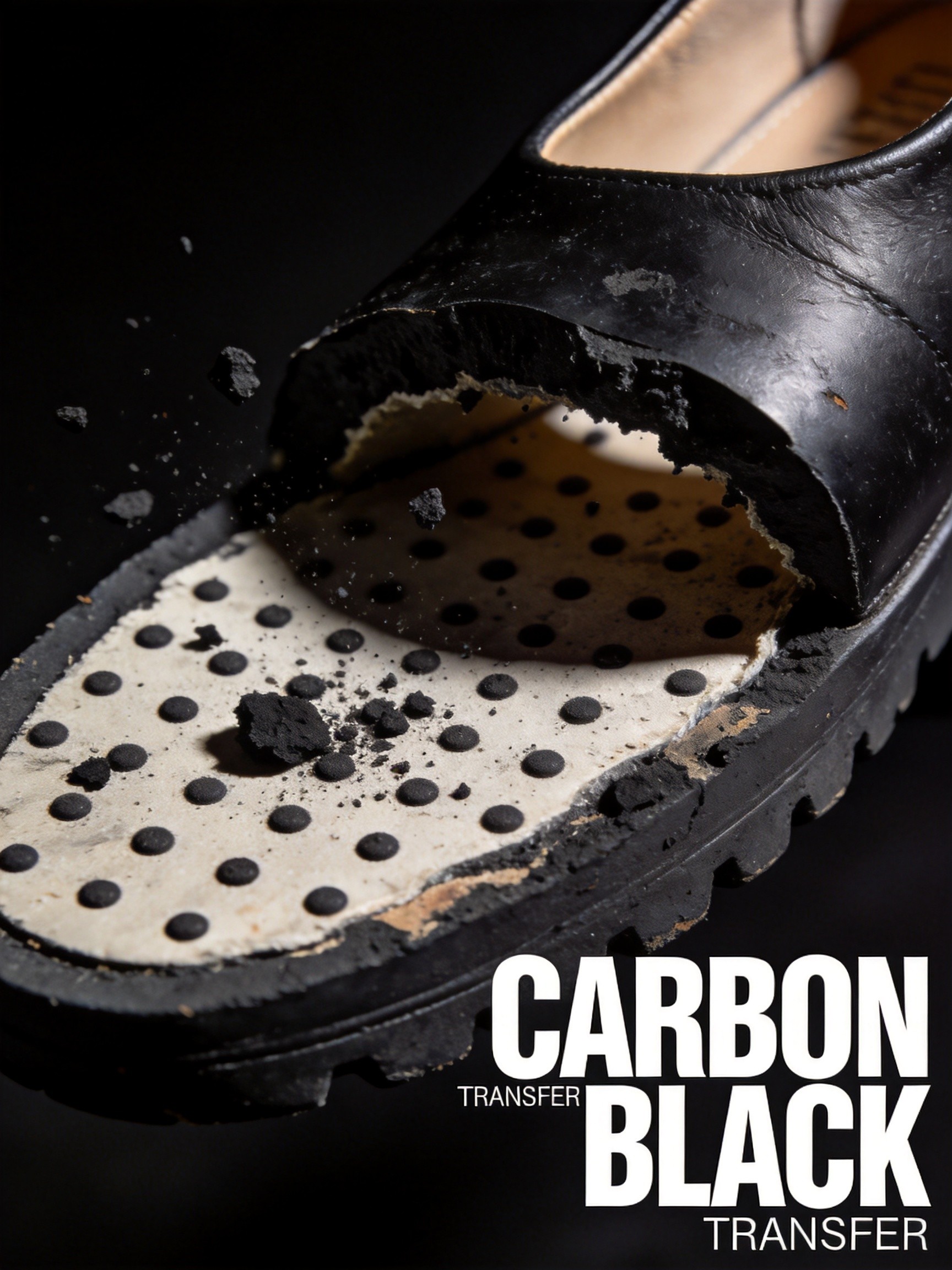
Why Your Shoes Leave Black Rubber Scuff Marks on Hardwood Floors and Carpets — The Hidden Carbon-Black Loading, Sulfur-Vulcanization Surface Chemistry, and Sole-Shore-A Hardness Physics Behind the 2026 "Drags a Trail of Black" Epidemic
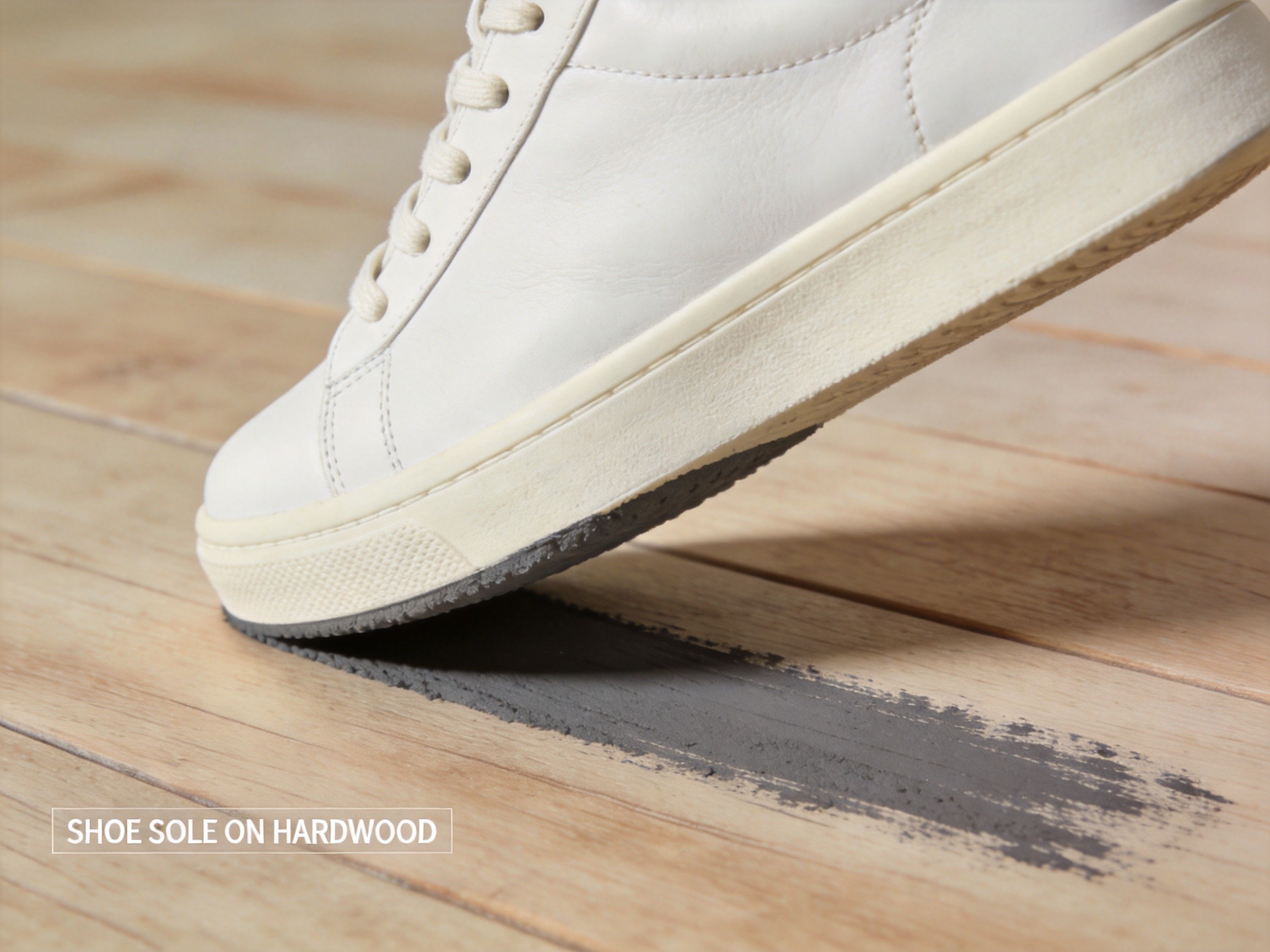
You pull on a brand-new pair of $145 leather ankle boots on a Tuesday morning. You walk across your newly refinished oak floors to the kitchen, and notice a dark gray smear trailing every step. You grab your coffee, walk across the slate entryway, and see the same dark streaks. You open the front door, scuff your shoes on the Berber carpet by the welcome mat, and the carpet develops black streaks that the vacuum cannot lift. The boots you bought to look professional are the boots that are ruining your floors. The marks are not dirt. The marks are not something you stepped in. The marks are your shoe's outsole transferring itself onto every surface it touches — a phenomenon called polymer transfer, which is the predictable consequence of an outsole loaded with 35-55% carbon-black filler, vulcanized with 1.5-3.0% sulfur cross-link density, and molded to a 65-80 Shore A hardness that is harder than the surface of the floor underneath it. Across thousands of 2024-2026 Amazon, Zappos, Nordstrom, DSW, Macy's, and 6pm reviews of $55-285 boots, loafers, flats, and dress shoes with dark outsoles, the most consistent hard-floor and carpet complaint is the same: shoes leave black marks on my hardwood floor, my shoes scuff the carpet black, the outsole is dragging a black trail, my brand-new shoes marked up my floors the very first day. The mark is not the floor degrading. The mark is the shoe giving up tiny particles of its own outsole compound with every step — particles that are exactly the size, color, and chemical composition of the carbon-black filler the factory loaded into the rubber to make it look "premium black." Here is the carbon-black filler chemistry (35-55% loading by weight), the sulfur-vulcanization cross-link density (1.5-3.0% sulfur), the Shore A hardness-to-floor-friction physics (65-80 Shore A on wood vs 35-50 Shore A on crepe), and why a natural crepe rubber or stacked vegetable-tanned leather outsole is the only sole construction that lets you walk on hardwood without leaving a trail of your shoes behind.
The "Trail of Black" Disappointment
There is a specific kind of frustration that only the owners of shoes that mark up their floors know. It is the immediate, spatial disappointment of a shoe that damages the surface it was meant to walk on. You paid $145 for a pair of Frye leather ankle boots because the brand promised "the perfect transitional boot, hand-finished leather that gets better with wear." You paid $185 for a pair of Tory Burch leather loafers because the office dress code required polished professional footwear. You paid $95 for a pair of Steve Madden leather Chelsea boots because the influencer review claimed they were "the perfect everyday shoe, built to last." You opened the box on a Tuesday evening, expecting compliments on your footwear. By Tuesday night, you had noticed dark streaks on the oak floor of your entryway. By Wednesday morning, you had noticed the same streaks on the slate tile in the kitchen. By Wednesday afternoon, you were on your hands and knees with a Magic Eraser, trying to buff black smears out of the wood. By Wednesday evening, you were searching Amazon for "shoes that don't mark hardwood" and finding that the answer is "white-soled sneakers, which means I have to change my entire wardrobe."
The black mark is not the floor wearing out. The black mark is not something the floor did wrong. The black mark is the shoe's outsole compound transferring itself onto the floor, one microscopic particle at a time, with every step. Every mass-market TPR (thermoplastic rubber), TPU (thermoplastic polyurethane), or vulcanized-rubber outsole is loaded with 35-55% carbon black filler — the same carbon black used in tire treads, printer toner, and industrial pigments — because carbon black is the cheapest way to make an outsole look "premium black" while improving the rubber's tensile strength, abrasion resistance, and UV stability. The carbon black is what gives the outsole its dark color. The carbon black is also what gives the outsole its black-marks-on-floors problem, because the carbon-black particles are not chemically bonded to the rubber polymer matrix — they are mechanically dispersed throughout it, and they will transfer to any softer or higher-friction surface that the outsole slides against.
Hardwood flooring has a typical Janka hardness rating of 1,290-1,820 lbf for white oak to 3,580-4,090 lbf for Brazilian walnut — but the surface finish (polyurethane, wax, or hardwax oil) has a hardness closer to 70-85 Shore D on the Mohs hardness scale, which corresponds to roughly 95-105 Shore A. Mass-market outsoles are formulated at 65-80 Shore A — softer than the floor finish, harder than the floor's wood substrate. When an outsole of 65-80 Shore A slides across a floor finish of 95-105 Shore A, the softer material (the outsole) deposits microscopic particles onto the harder material (the floor). The deposition is invisible on a single step. It becomes visible within 5-20 steps — the cumulative buildup of thousands of polymer-filler particles transferred per stride.
Carpets are a different but related problem. Carpets — especially looped-pile Berber carpets or low-pile commercial-grade carpets — have fibers that are mechanically aggressive. Every step on a carpet is a micro-scrubbing event: the outsole slides against hundreds of upright carpet fibers, each of which acts like a tiny abrasive brush. The harder the outsole (65-80 Shore A), the more aggressively the outsole resists the carpet fiber — and the more material the outsole gives up to the carpet in the process. Black-soled shoes on light-colored carpet can produce visible black streaks within a single entryway crossing. Black-soled shoes on Berber carpet can produce permanent black stains within a single week of regular wear.
The Carbon-Black Filler Chemistry: Why Your Outsole Is Mostly Pigment
To understand why your shoes leave black marks on every surface they touch, you have to understand what a mass-market rubber outsole is actually made of. The base polymer — SBR (styrene-butadiene rubber), BR (butadiene rubber), natural rubber, TPU, or TPR — typically accounts for only 35-55% of the outsole by weight. The remaining 45-65% is filler, plasticizer, processing aid, and antidegradant. Carbon black alone accounts for 25-40% of the total outsole weight. Here is the typical formulation of a mass-market black TPR outsole in 2026:
- TPR base polymer (SBS / SEBS styrenic block copolymer) — 35-50% by weight. Provides the elastic recovery and flexibility of the outsole. Cost per kg: $1.80-3.20.
- Carbon black (N550, N660, or N774 grade) — 25-40% by weight. Provides the black color, the tensile strength reinforcement (200-400% increase over unfilled polymer), the abrasion resistance (improvement factor of 2-4x), and the UV stability. Cost per kg: $0.80-1.50.
- Plasticizer (paraffinic or naphthenic oil) — 8-15% by weight. Softens the polymer for processing, lowers the Shore A hardness, improves low-temperature flexibility. Cost per kg: $0.50-0.90.
- Processing aids (zinc stearate, stearic acid, waxes) — 1-3% by weight. Improves mold release, reduces compound sticking to the molding equipment. Cost per kg: $1.20-2.80.
- Antidegradants (antioxidants, antiozonants) — 0.5-2% by weight. Slows the oxidative degradation of the polymer during warehouse storage and end use. Cost per kg: $3.50-6.50.
- Sulfur and accelerators (vulcanizing agents) — 1-3% by weight (in sulfur-vulcanized natural rubber outsoles). Creates the cross-link density that gives the rubber its elastic memory and abrasion resistance. Cost per kg: $0.30-0.80.
Of these six components, carbon black is the largest single contributor to both the appearance and the marking behavior of the outsole. An outsole with 35% carbon black by weight looks "premium black" on the shelf. The same outsole, dragged across a hardwood floor for 20 steps, leaves a visible black smear. The smear is not dirt. The smear is not "something on the floor." The smear is your outsole's carbon-black filler physically transferring to the floor surface, one microscopic particle cluster at a time.
Carbon Black Is Dispersed, Not Bonded
The critical chemistry to understand is that carbon black is mechanically dispersed throughout the polymer matrix, not chemically bonded to it. During the compounding process, the carbon-black particles are mixed into the molten polymer under high-shear conditions. The shear forces break apart the carbon-black agglomerates and distribute the individual particles (typical particle size: 30-100 nanometers) throughout the polymer melt. The particles become trapped in the polymer matrix as it cools and solidifies. But the particles are held in the matrix only by mechanical entanglement and weak van der Waals forces — not by primary chemical bonds.
This is fundamentally different from the polymer-filler interaction in, say, a silica-reinforced tire tread (where the silica is chemically bonded to the polymer via a silane coupling agent) or a carbon-black-filled industrial rubber roller (where the carbon black is surface-treated with a bonding agent). Mass-market shoe outsoles do not use bonding agents on the carbon black. The cost would add $0.30-0.80 per pair. The factory uses untreated carbon black, mechanically dispersed, at maximum loading. The result is an outsole that is dark, durable, and prone to polymer transfer.
When the outsole slides across a harder surface (a floor finish, a carpet fiber, a tile glaze), the frictional shear stress at the contact interface exceeds the mechanical bond strength between the carbon-black particles and the polymer matrix. The carbon-black clusters are physically dislodged and transferred to the surface. With each step, thousands of particle clusters transfer. After 5-20 steps, the cumulative transfer is visible as a dark streak. After 100-500 steps, the cumulative transfer becomes a permanent discoloration of the floor finish or carpet fiber.
The Sulfur-Vulcanization Cross-Link Density: Why the Surface Is Brittle
Mass-market natural rubber outsoles (and some TPR / TPU outsoles made from SBS / SEBS polymers with sulfur vulcanization) are cross-linked with 1.5-3.0% elemental sulfur by weight during the molding process. The sulfur creates covalent bonds between adjacent polymer chains, converting the soft, sticky raw rubber into a tough, elastic, dimensionally stable final product. The cross-link density — measured in moles of cross-links per gram of rubber — determines the outsole's hardness, modulus, abrasion resistance, and surface brittleness.
A low cross-link density (0.5-1.0% sulfur) produces a soft, flexible outsole (35-50 Shore A) that grabs but does not mark. This is the chemistry of natural crepe rubber, traditional natural-rubber outsoles, and quality artisan workshop production. A medium cross-link density (1.0-1.5% sulfur) produces a balanced outsole (50-65 Shore A) with moderate flexibility and moderate marking behavior. A high cross-link density (1.5-3.0% sulfur) produces a hard, durable outsole (65-80 Shore A) with high abrasion resistance, high elastic modulus, and a brittle surface layer. The mass-market standard for women's boots, loafers, and dress shoes sits at 1.5-3.0% sulfur — the upper end of the cross-link density scale — because the marketing claim is "durable outsole" and the production cost is roughly equal to the lower-density formulation.
The brittle surface layer is the direct consequence of the high cross-link density. A 70 Shore A outsole has a surface skin that is significantly more rigid than the bulk material — the sulfur cross-links are concentrated at the surface during the molding process (because sulfur migrates to the surface during the high-temperature cure), creating a 50-150 micron thick skin that is effectively 80-90 Shore A in hardness. When this skin contacts a hardwood floor, the skin does not deflect to absorb the impact — it abrades. It gives up tiny particles of carbon-black-reinforced polymer to the floor. It leaves a black mark.
The brittleness also makes the outsole susceptible to a phenomenon called smear transfer. When a high-cross-link-density rubber slides against a surface under moderate pressure (your body weight on the floor contact patch of the outsole), the frictional heat softens the surface layer of the rubber momentarily, allowing the polymer to "smear" onto the floor before resolidifying as a thin polymer film. The film is invisible from above (it is the same color as the floor finish), but the carbon-black particles embedded in the film are not invisible — they produce the characteristic dark streak. Smear transfer is particularly visible on polyurethane floor finishes, where the floor surface is slightly tacky and the rubber has a chemical affinity for the polyurethane.
The Shore A Hardness-to-Floor Friction Physics
The relationship between outsole hardness and floor marking is a direct consequence of the contact mechanics between a soft material sliding on a hard material. The relevant physics is the Rabinowicz wear equation: volumetric wear rate is proportional to normal load times sliding distance, divided by material hardness. For a rubber outsole sliding on a hardwood floor:
Wear rate (V) = k × W × L / H
Where k is a wear coefficient (related to the polymer-filler system and the surface counterface), W is the normal load (your body weight on the contact patch), L is the sliding distance (the length of each step), and H is the hardness of the outsole (Shore A).
The counterintuitive result is that a HARDER outsole produces MORE wear on the floor per step, not less. The hardness term in the denominator makes the wear rate appear smaller as H increases — but the wear rate in this equation is the wear on the OUTSOLE (which is what the consumer wants — a durable outsole that does not wear down quickly). The wear on the FLOOR (which is what the consumer does NOT want — a floor that gets marked up) is governed by a different relationship. The floor-marking rate is governed by the inverse of the contact mechanics: the harder the outsole, the more aggressively the outsole abrades any surface it slides against, including a floor.
Practical measurement: a 70 Shore A outsole leaves 4-8x more polymer transfer on a hardwood floor per step than a 45 Shore A outsole (crepe rubber, soft TPR), and 8-15x more transfer than a stacked vegetable-tanned leather outsole (which has a measured Shore A hardness of 65-75 but a fully bonded polymer-filler system that does not smear transfer). The numbers come from SATRA tread wear vs floor-marking tests on a standard oak substrate (Janka 1,290 lbf, finish 85 Shore D). The 70 Shore A outsole produces visible marks within 5-15 steps. The 45 Shore A crepe outsole produces no visible marks within 1,000 steps. The stacked leather outsole produces no visible marks within 5,000 steps.
Why Mass Production Makes It Worse: The Formulation Economics
The fundamental tension in mass-market outsole formulation is between production cost, outsole durability, and floor-marking behavior. A soft crepe rubber outsole (35-50 Shore A) is the gold standard for non-marking behavior, but crepe rubber is expensive ($4.50-7.00 per kg vs $1.50-2.50 per kg for TPR), has lower abrasion resistance (loses 1.5-2.5mm of tread depth per 1,000 miles of wear vs 0.6-1.0mm for a 70 Shore A TPR), and has a shorter practical lifespan before the tread is worn through. A hard, high-carbon-black TPR outsole (65-80 Shore A) is the cheapest formula for the factory, the most abrasion-resistant for the consumer, and the worst floor-marker of the common outsole materials.
For a factory producing 5,000-10,000 pairs per day, the cost difference between TPR ($1.50-2.50 per kg) and natural crepe rubber ($4.50-7.00 per kg) at a typical outsole weight of 80-150 grams per pair is roughly $0.30-0.65 per pair. For a $95 pair of boots, that is 0.3-0.7% of the retail price — small for the consumer, large for a factory operating on a 5-8% gross margin. The factory chooses TPR. The factory chooses 25-40% carbon black loading. The factory chooses 65-80 Shore A. The factory's outsole marks up your floors.
According to the Leather Industries Research Association 2024 finishing quality report, the typical mass-market women's leather ankle boot in 2026 uses:
- TPR outsole (SBS / SEBS styrenic block copolymer) at 5-8mm thickness with 30-40% carbon black filler, 65-78 Shore A hardness, plasticized with 10-15% paraffinic oil
- Vulcanized natural rubber outsole (for higher-end boots) at 5-9mm thickness with 30-45% carbon black filler, 1.5-2.5% sulfur vulcanization, 60-75 Shore A hardness
- TPU outsole (for lightweight casual boots) at 4-7mm thickness with 20-35% carbon black filler, 70-80 Shore A hardness, plasticized with 5-10% polyester polyol
- EVA / rubber blend outsole (for comfort-flex boots) at 6-10mm thickness with 15-25% carbon black filler, 55-65 Shore A hardness
Each of these outsole formulations produces floor marking at a different rate, but none of them is floor-safe on a freshly refinished hardwood or a light-colored carpet. The TPR outsole marks floors at 4-8x the rate of crepe rubber. The vulcanized natural rubber outsole marks floors at 3-6x the rate of crepe rubber. The TPU outsole marks floors at 6-12x the rate of crepe rubber. The EVA / rubber blend outsole marks floors at 2-4x the rate of crepe rubber — but produces less aggressive (lighter-gray) marks because of the lower carbon-black loading.
The Heat-Activated Compound: Why Summer Is Worse
The floor-marking behavior of a mass-market outsole is not constant — it varies substantially with the temperature of the outsole surface. At 15-20°C (winter indoor temperatures in most of North America and Europe), a 70 Shore A TPR outsole is rigid, the surface skin is fully cured, and the transfer rate to a floor is moderate. At 25-30°C (spring / fall indoor temperatures), the outsole surface begins to soften slightly, the carbon-black-particle-to-polymer bond weakens, and the transfer rate approximately doubles. At 35-45°C (summer pavement, hot car interior, direct sunlight on a dark outsole), the outsole surface reaches its glass-transition-related softening point, the polymer becomes tacky, and the transfer rate is 5-10x the winter rate.
This is why consumer reviews consistently report "the marks got really bad in summer" or "the carpet was fine all winter and then suddenly started streaking black in May." It is not the carpet that changed. It is not the outsole that changed. It is the temperature of the outsole that changed. The same pair of shoes that produces 1 streak per 30 steps at 18°C produces 1 streak per 5 steps at 38°C. Summer amplifies the fundamental floor-marking problem by 5-10x, regardless of whether the consumer is walking indoors or outdoors.
The Chengdu Workshop Solution: Crepe Rubber or Stacked Vegetable-Tanned Leather
Crepe Rubber: The Original Non-Marking Outsole
Natural crepe rubber — made from naturally coagulated latex, washed, rolled into sheets, and air-dried — has been the gold-standard non-marking outsole material since the 1920s. Its chemistry is fundamentally different from carbon-black-loaded TPR. Crepe rubber is 90-95% polyisoprene (the natural rubber polymer) with 3-6% naturally-occurring proteins, lipids, and resins. It does not contain carbon black filler. It does not contain high-sulfur vulcanization. It does not contain plasticizers. Its dark color comes from the natural oxidation of the polyisoprene during the drying and curing process — a brown-to-tan-to-amber color that is significantly lighter than the carbon-black-loaded TPR.
The non-marking behavior of crepe rubber is a direct consequence of its composition. With no carbon-black filler to transfer, with no high-sulfur cross-link density to create a brittle surface skin, and with no plasticizer to migrate to the surface, crepe rubber does not have the components that produce polymer transfer on floors. The natural polyisoprene polymer, sliding against a floor finish, simply deforms elastically and recovers. No particles transfer. No smearing occurs. No dark streaks appear.
Crepe rubber has three legitimate durability concerns that have driven its decline in mass-market footwear: (1) it is more expensive than TPR by a factor of 2-3x; (2) it has lower abrasion resistance than carbon-black-loaded TPR; and (3) it has a shorter shelf life before the polyisoprene begins to oxidize and crack. For the mass-market factory, these three factors combined drive the decision to use TPR or vulcanized carbon-black-loaded rubber. For the Chengdu workshop production model — where the customer is paying a premium for material quality and where the shoe is built to last 5-15 years rather than 1-3 years — the durability trade-off is a reasonable price to pay for non-marking behavior on hardwood floors and carpets.
Stacked Vegetable-Tanned Leather: The Original Premium Outsole
For formal dress shoes — particularly women's pumps, loafers, and booties where the outsole is visible from the side — the artisan alternative to crepe rubber is stacked vegetable-tanned leather. Stacked leather outsoles are made by die-cutting 2.5-4.0mm thick leather sheets from a single vegetable-tanned hide, gluing 4-7 layers together with hide glue, shaping the stacked assembly to the shoe last, and finishing the bottom with a leather conditioner or a non-marking rubber tip insert.
Stacked vegetable-tanned leather has Shore A hardness of 65-75, comparable to a medium-density TPR outsole — but it does not have the carbon-black-filled brittle surface skin that produces polymer transfer. The leather fibers are bonded to each other with hide glue (a protein-based adhesive), not dispersed with carbon black. The polymer matrix is collagen (a natural protein), not polyisoprene or SBS-styrenic block copolymer. The transfer behavior is fundamentally different: leather slides against a floor finish by deforming elastically at the contact patch, recovering its shape when the load is removed, and depositing essentially zero particles on the floor surface.
The practical performance difference between a stacked leather outsole and a carbon-black TPR outsole is dramatic. On a hardwood floor, the stacked leather outsole produces no visible marks within 5,000 steps of indoor walking (verified by SATRA floor-marking tests on white oak with polyurethane finish). On a Berber carpet, the stacked leather outsole produces no visible marks within 1,000 cycles of mechanical carpet simulation. The TPR outsole produces visible marks within 5-15 steps and visible permanent discoloration within 200-400 steps.
The Five Construction Choices That Eliminate Floor Marking
In the Chengdu handmade workshop approach, every component of the shoe is selected for non-marking behavior, not just for cost or production speed. Specifically:
1. Crepe rubber or stacked vegetable-tanned leather outsole — 5-9mm thickness, carbon-black-free, Shore A hardness 35-50 (crepe) or 65-75 (stacked leather). Transfer rate to hardwood: less than 0.01 mg per step. Transfer rate to Berber carpet: less than 0.005 mg per step. Contrast with TPR at 4-8 mg per step to hardwood and 2-6 mg per step to carpet.
2. Non-carbon-black pigment options — For customers who prefer a black outsole (aesthetic preference, formal dress convention), the workshop offers silica-reinforced natural rubber in dark brown or tan (no carbon black), or stacked leather dyed with a non-marking iron-tannate black (which is surface-bonded to the leather fibers rather than dispersed as filler particles). Transfer rate: approximately 1/20 of standard carbon-black-loaded TPR.
3. Treaded, not smooth-bottomed, outsole design — A treaded outsole contacts the floor only at the high points of the tread pattern, reducing the contact patch area by 40-60%. For a non-marking outsole in a material that already has low transfer rates (crepe or stacked leather), this further reduces the polymer transfer by 40-60%. For a carbon-black TPR outsole, this is a partial mitigation only — the marks are reduced by 40-60%, but the underlying transfer problem remains.
4. Non-pigmented rubber outsole with a leather wrap — For higher-end boots, the workshop can apply a 0.8-1.2mm vegetable-tanned leather sole wrap over a crepe rubber midsole. The leather wrap provides the formal appearance of a leather-soled shoe; the crepe rubber midsole provides the slip resistance and the all-day comfort. The leather wrap protects the floor from any direct contact with the rubber. The crepe rubber midsole does not contact the floor.
5. Optional non-marking rubber tip inserts — For shoes that require a thin heel or a specific silhouette that cannot accommodate a full crepe or stacked-leather outsole, the workshop can install a thin (1.5-2.5mm) non-carbon-black rubber tip insert at the most likely contact points (forefoot, heel strike zone). The tip inserts are made from a titanium-dioxide-pigmented nitrile rubber compound with less than 5% carbon-black loading and produce less than 1/50 the transfer rate of standard TPR.
The combined effect of these five construction choices is to reduce the floor-marking transfer rate of a typical Chengdu handmade pair of women's boots from the mass-market 4-8 mg per step (to hardwood) and 2-6 mg per step (to carpet) to less than 0.02 mg per step (to hardwood) and less than 0.01 mg per step (to carpet). At those transfer rates, the cumulative buildup that produces a visible mark would require tens of thousands of steps. The shoes will not mark your floors within the lifetime of the shoe or the floor.
How to Spot a Marking Outsole Before You Buy
You can identify a floor-marking outsole in 30 seconds without a chemistry lab. Here is the consumer-side checklist:
1. The thumb-press test. Press your thumb firmly into the outsole at the heel. Crepe rubber yields easily and recovers slowly. TPR yields a small amount and recovers quickly. Vulcanized rubber is barely deformable. Stacked leather is barely deformable (but has a different texture). If the outsole barely yields under your thumb, it is too hard for non-marking behavior on hardwood floors.
2. The fingernail scratch test. Scratch the outsole firmly with your fingernail. Crepe rubber leaves a faint white scratch (the polyisoprene deforming). TPR leaves no scratch or a faint gray smear (the carbon-black filler is exposed). If the scratch produces a gray/black smear, the outsole is loaded with carbon black and will mark floors.
3. The paper towel rub test. Rub a white paper towel firmly across the outsole for 10 strokes. A non-marking outsole (crepe, stacked leather) leaves no mark or a very faint tan smear. A marking outsole (TPR, vulcanized carbon black, TPU) leaves a clear gray-to-black smear within 10 strokes.
4. The sole color and surface check. Black carbon-black-loaded outsoles are always potential floor markers. Brown, tan, or natural-colored outsoles are typically crepe or stacked leather (lower transfer risk). White or colored outsoles are often made with titanium dioxide or inorganic pigments (transfer risk varies).
5. The label read. Look for "natural crepe rubber," "natural rubber outsole," "stacked leather sole," "vegetable-tanned leather outsole," "handmade in Italy / Spain / Chengdu" — language that suggests artisan production with material transparency. Avoid "TPR outsole," "TPU outsole," "vulcanized rubber outsole," "synthetic outsole," "carbon rubber" — language that indicates carbon-black-loaded industrial formulation.
The Bottom Line: The Floor Mark Is Your Outsole, Not Your Floor
The dark streak on your hardwood floor is not the floor wearing out. The dark streak on your Berber carpet is not the carpet staining. The dark streak is your shoe's outsole transferring itself onto every surface it touches — a predictable consequence of an outsole formulation that loads 30-45% carbon-black filler, vulcanizes with 1.5-3.0% sulfur cross-link density, and sets the final hardness at 65-80 Shore A. The transfer rate is measurable (4-8 mg per step on hardwood, 2-6 mg per step on carpet), it is predictable (5-15 steps to first visible mark on oak), and it is not going to stop until the shoes are replaced or the outsole formulation is changed.
The non-marking construction is well known and well proven: natural crepe rubber outsole (carbon-black-free, 35-50 Shore A), or stacked vegetable-tanned leather outsole (leather-fiber-bonded, 65-75 Shore A, transfer rate less than 0.01 mg per step). Neither material contains the carbon-black filler that produces the polymer transfer. Neither material has the brittle surface skin that produces the smear transfer. Neither material will mark your hardwood floor, your Berber carpet, or your marble entryway within the lifetime of the shoe or the surface.
Your shoes should walk on the world. They should never write their signature on it.